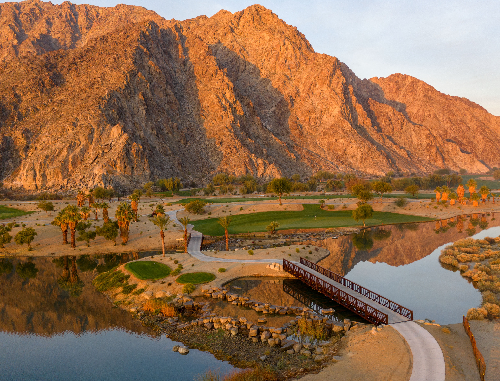
There are harder courses by slope rating in America, but none that have been as intentionally designed to create suffering as the Stadium Course. Pete and Alice Dye weren't working from a brief to build something playable — they were asked to maximise difficulty, and every design decision reflects that mandate. The amphitheatre mounding, the island green on 17, the 19-foot pit on 16, the railroad ties framing hazards throughout — these are not design flourishes but expressions of a specific architectural philosophy taken to its logical extreme. The 2024 Tim Liddy restoration was the most significant work done to the course since opening, returning all greens to original Dye dimensions and rebuilding bunkers to period specifications. The American Express PGA Tour event tests the course annually alongside the Nicklaus Tournament Course, and the conditioning is maintained to a standard the schedule demands. The PGA West Golf Academy and Performance Lab on-site provides context for how good golfers learn to play here.
Golf DigestAmerica's 100 Greatest Public Courses — #622025–26
Golf DigestBest in State, California — #362025–26
GOLF MagazineTop 100 Courses You Can Play in the U.S. — #562024–25
GolfweekBest Public Courses in California — #112025
4 things worth knowing before your round — from tee selection to where to eat when you're done.
01
Course Character & Design
Pete and Alice Dye built the Stadium Course in 1986 to an explicit brief: maximize difficulty. The result is a 148-slope layout that has earned its reputation as one of the most demanding public courses in America. This is not marketing language — the Stadium was literally commissioned to be the hardest course in the world, and the design delivers on that brief across all 18 holes. Golf Digest's America's 100 Greatest Public Courses list includes it for a reason. Tim Liddy's comprehensive 2024 restoration returned all greens to original Dye dimensions with TifEagle Bermuda.
02
Signature Holes
Hole 17, 'Alcatraz,' is the most famous — an island-green par-3 that was the stage for Lee Trevino's $175,000 hole-in-one in the 1987 Skins Game. Hole 16, 'San Andreas Fault,' features a 19-foot-deep bunker that has to be seen to be believed. But the difficulty is not concentrated in these showcase holes — it is relentless from the first tee to the last putt. Play the appropriate tees; ego-driven tee selection here leads to genuinely unpleasant rounds.
03
Course Conditions
TifEagle Bermuda greens are maintained to The American Express tournament standards alongside the Nicklaus Tournament Course. The 2024 Liddy restoration is the most comprehensive work the Stadium has received since opening, and the course is playing as close to Dye's original intent as it has in decades. Ernie's Bar & Grill serves the Stadium and Nicklaus courses.
04
Before You Play
Play the right tees. The 7,300-yard, 154-slope championship setup is a PGA Tour venue — if you're not a scratch player, moving forward isn't a concession, it's the intelligent play. PGA West Golf Academy and the Performance Lab are the most comprehensive practice facilities in the valley. Walking is allowed but the course's scale and intensity make a cart advisable. Green fees of $75–$399 reach the highest peak-season rates in the Coachella Valley, reflecting both the brand and the American Express tournament association.
InstructionPGA West Golf Academy / Performance Lab
DiningErnie's Bar & Grill
LodgingLa Quinta Resort & Club
Green Fees $75 – $399
Best MonthsNovember-April
Peak SeasonJanuary-April
Nearest AirportPSP · 30 min
Notable Features
Pete and Alice Dye's 1986 masterwork, built to the literal brief of maximizing difficulty; 148 slope rating; hole 17 'Alcatraz' — island-green par-3 — was the stage for Lee Trevino's $175,000 hole-in-one in the 1987 Skins Game; hole 16 'San Andreas Fault' features a 19-foot deep bunker; Golf Digest America's 100 Greatest Public Courses; comprehensive Tim Liddy restoration completed 2024, returning all greens to original Dye dimensions with TifEagle Bermuda.
Tee Information
Scorecard
Tee
Gender
Par
Yardage
Rating
Slope
Black
M
72
7,300
76
148
Black/Blue
M
72
7,005
74.6
145
Blue
M
72
6,739
73.4
141
Blue/White
M
72
6,383
71.7
137
White
M
72
6,166
70.6
134
White/Gold
M
72
5,838
69
129
Gold
M
72
5,700
68.4
127
Gold/Red
M
72
5,370
66.8
122
Red
M
72
5,092
65.5
118
Red/Silver
M
72
4,546
63
111
Silver
M
72
4,084
60.9
106
◆
Ratings and yardages are approximate and may vary by season. Verify with the pro shop before your round.
Photo Gallery
PGA West – Stadium Course in Pictures
◻
◻
◻
+
View All Photos
Community Reviews
What Golfers Are Saying
★Reviews are coming soon. We're gathering verified golfer feedback from GolfPass, TripAdvisor, and other trusted sources.
⛳ PGA West – Greg Norman Course — Less than 1 mile away
FAQ
Common Questions
A 148 slope from the tips is a genuine number — this is one of the most demanding public courses in America. Single-digit handicappers will find it a serious test; higher handicaps should play from shorter tees or consider the Dunes or Greg Norman courses instead.
Hole 17 is a par-3 playing to an island green completely surrounded by water — the most photographed hole on the course. Lee Trevino's $175,000 hole-in-one here at the 1987 Skins Game is the hole's most famous moment. Club to the center; the pin position is irrelevant.
Hole 16 features a bunker 19 feet deep — not a typo. It is not a recovery situation; it is a stroke penalty. Play well clear of it.
Include in Your Itinerary
Make it a trip worth talking about
Let our specialists pair PGA West – Stadium Course with the right accommodation, supporting courses,
and a tee time sequence that makes the most of your days in La Quinta, CA.